
At the Department of Technological Machines and Transport, a number of events were held as part of the department’s Methodological Week.
On 20 November, a scientific and educational session was held on the topic “Trends in the Development of Modern Technological Machines and Transport.” The audience of students and academic staff was addressed by Professor of the Department, Candidate of Technical Sciences, Associate Professor Zora Muldagaliev. In his presentation, he examined the key directions in the development of transport and technological machines: the implementation of modern control systems, the use of energy-efficient and environmentally friendly technologies, the development of autonomous and electric transport, as well as the application of modern design methods in mechanical engineering. Special attention was paid to the role of transport and technological machines in industry, construction, the agricultural sector, and logistics.

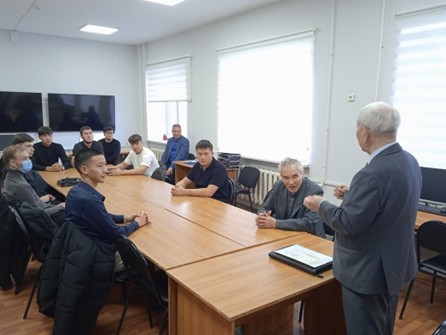
Scientific and educational session with Professor of the Department Zora Muldagaliev on the topic “Trends in the Development of Modern Technological Machines and Transport”
On 25 November, an open practical class was held for the course “3D Modeling Systems and AI 3D Generators” on the topic “Assembly of Parts in KOMPAS-3D.” The class was conducted by the department lecturer, Master of Engineering, Ilgar Tavshanov. The aim of the session was to construct 3D models of shafts and mechanical transmissions with subsequent assembly of units in the KOMPAS-3D environment. During the practical work, students practiced the stages of creating parametric models of parts, setting up mates, checking the correctness of kinematic constraints, and visually analyzing the operation of the mechanism. The students became familiar with the possibilities of integrating AI-generated results with traditional CAD systems, which makes it possible to accelerate development and increase the variability of engineering solutions. The open format of the class made it possible to demonstrate the department’s practice-oriented approach to teaching, as well as to highlight the role of digital modeling technologies in training future specialists in transport and technological machines.
Open practical class with department lecturer Ilgar Tavshanov on the topic “Assembly of Parts in KOMPAS-3D”
On 27 November, an open class was held for the course “3D Modeling Systems and AI 3D Generators” on the topic “Fundamentals of 3D Assembly, 3D Digitization, 3D Scanning and 3D Printing.” The class was conducted by Senior Lecturer of the Department, PhD Maxat Abishkenov. Its aim was to introduce students to the basic principles of three-dimensional assembly, methods of digitizing real objects, and the capabilities of additive technologies, drawing on the department’s real scientific developments and practical case studies of their application. Using a teaching presentation, the lecturer demonstrated the areas of application of 3D assembly—from mechanical engineering, animation, and simulation modeling (FEM, CFD, DEM models) to architecture, medicine, education, and the use of artificial intelligence methods for automated generation of 3D objects. Special attention was given to the integration of classical CAD systems with modern AI 3D generators, which opens up new possibilities for accelerating engineering exploration and optimizing designs.
Open class with Senior Lecturer of the Department Maxat Abishkenov on the topic “Fundamentals of 3D Assembly, 3D Digitization, 3D Scanning and 3D Printing”
The practical part of the class was focused on the department’s real projects. A demonstration table was prepared for students with samples of parts and assemblies developed at the department in the course of scientific research: elements of a rolling mill, parts of experimental setups, samples for studying processes of plastic deformation, casting, and others. These items had previously been designed using 3D modeling and assembly and were then used in numerical simulations and laboratory experiments. Students were able to compare the physical samples with their digital prototypes and see how the results of 3D assembly are used in calculating stress–strain states, modeling material flows, and optimizing technological parameters.
Demonstration table with samples of parts and assemblies developed at the department in the course of scientific research using 3D technologies
The Methodological Week concluded with a mini-conference on the topic “Future Directions of Students’ Research.” The purpose of the event was to increase students’ interest in the department’s research activities, to present and discuss promising research projects of the department’s master’s and doctoral students, and to form among senior undergraduate students an understanding of current trends in the field of transport and technological machines and digital design technologies.
Representatives of the academic staff delivered welcoming remarks, outlining the department’s priority research areas: the development of intelligent transport and technological complexes, improvement of machine and unit working bodies, digital twins and numerical modeling of technological processes, and the implementation of 3D modeling systems and AI technologies in engineering practice.
During the conference, master’s and doctoral students presented reports on the topics of their research: optimization of designs and operating modes of transport and technological machines, application of finite element and simulation modeling methods to analyze the stress–strain state of assemblies, and development of experimental test rigs and testing methodologies.
Mini-conference on the topic “Future Directions of Students’ Research”
After the presentations, an in-depth discussion unfolded. Instructors asked clarifying questions regarding research methodologies, the choice of mathematical models, experimental design, and interpretation of results. Possible ways of expanding research topics, cooperation with other departments and research centers, and students’ participation in grant projects and research competitions were discussed. Undergraduate students had the opportunity to communicate directly with master’s and doctoral students and to ask questions about choosing a research focus, the structure of master’s and doctoral programs, and the prospects of an academic career.
Просмотров: 1